Weekly YouTube Digest — Jun 8–14, 2026
4 videos this week: the agentic loop engineering technique going viral among top engineers, four open-source AI tools that could cut your token costs by 90%, the inside story of how Anthropic's own fear marketing triggered a US government ban on Mythos and Fable, and NVIDIA's new 550B open-weight model with a permissive license.

Four videos worth your attention this week: the agentic loop engineering pattern that's dividing software engineers, four open-source tools that could reshape your daily AI workflow, the US government's surprising Mythos/Fable ban and why Anthropic may have brought it on themselves, and NVIDIA's new open-weight giant that's free to use, modify, and deploy forever.
Loop engineering: the technique only the top 1% are using
正在加载内容卡片…
Matthew Berman — "Only the best are using them..." | 12:59 | Jun 9 | 72K views
Two engineers at OpenAI and Anthropic — Peter Steinberger and Boris Cherny — went viral simultaneously last week with the same message: stop prompting coding agents, start designing loops. 1
A loop is dead simple in concept: a trigger, a goal, and an agent that keeps running until the goal is verified — either by tests passing or by another model judging completion. Steinberger's original tweet explaining this hit 5 million views in under 24 hours. 2
Where it gets interesting is what verifying the goal means in practice. Deterministic goals — all tests pass, no CI errors — are straightforward. Ambiguous goals like "build this feature" require specifying the full end state upfront, which is harder than it sounds. Berman draws an explicit parallel to reinforcement learning: the loop needs a reward signal, and defining that signal is the real engineering work.
The catch is cost. Steinberger logged $1.3 million in monthly token usage at OpenAI, where employees get uncapped budgets. For everyone else, loop engineering is more aspiration than daily practice — for now. Berman's take: expensive today, cheap tomorrow, and understanding it now puts you ahead of the curve.
Worth watching? Yes if you're doing any agentic coding. The explanation of triggers, goals, and the automation-vs-loop distinction is the clearest breakdown I've seen. Skip the last 5 minutes, which are mainly sponsor and self-reference.
Four open-source tools you probably missed
正在加载内容卡片…
Matthew Berman — "You NEED to try these open-source AI projects RIGHT NOW" | 15:54 | Jun 12 | 84K views
A roundup of four free GitHub projects, all installable as agent skills with a single copy-paste. The four: 3
Last30Days (40K+ GitHub stars) — a search engine that ranks results by Reddit upvotes, Hacker News score, X likes, YouTube engagement, and Polymarket odds. Co-founded by the same person who co-founded Lyft. Useful specifically for recent trending topics, not evergreen research. 4
Open Notebook (30K stars) — a local, open-source NotebookLM clone. Upload any document or URL, ask questions, or generate a full podcast discussion. Works with hosted models (GPT-5.5) or fully local via Ollama/LM Studio. Berman demos it generating a 23-minute podcast from a single essay.
Agent Skills (56K stars) — seven slash commands that map to seven stages of engineering: spec, plan, build, test, review, simplify, ship. Closer to a structured engineering workflow than a raw coding agent. 5
Headroom (24K stars) — a token compressor that wraps Claude Code, Cursor, or Codex. Berman shows it cutting a 100-result code search from 17K tokens to 1.4K — a 92% reduction. It also runs
headroom learn after sessions, mining failures to auto-write improvements to your CLAUDE.md. 6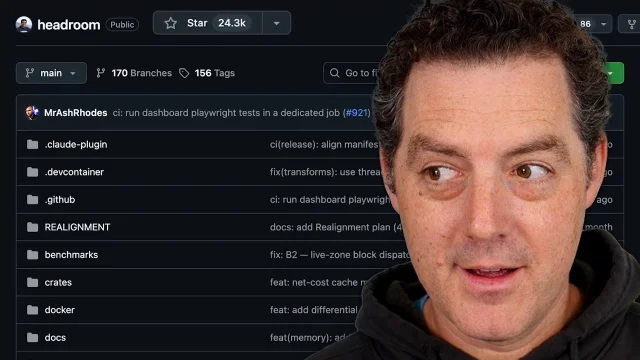
Worth watching? Yes. All four tools are genuinely underrated and the install demos are useful. Headroom in particular is the kind of thing most devs don't realize they need until they're burning through quota.
Why Anthropic's own fear marketing triggered a government ban
正在加载内容卡片…
Matthew Berman — "WTF is going on?!" | 15:48 | Jun 13 | 77K views
On Friday night, the US government issued an export control directive suspending all access to Fable 5 and Mythos 5 for foreign nationals — inside or outside the US. Anthropic received the directive at 5:21 PM Eastern and had both models offline within 3 hours. 7
The stated reason: the government claimed to have become aware of a jailbreak that could extract sensitive vulnerability information. Anthropic's response was that the specific technique identified only exposed "a small number of previously known minor vulnerabilities" — the same vulnerabilities extractable from other publicly available models without any jailbreak.
Berman's read is that Anthropic created this situation themselves. The sequence:
- Anthropic announces Mythos months earlier through "Project Glasswing" — framing it as too dangerous to release publicly, reserved only for vetted partners
- This generates massive hype but also government attention
- The Department of War previously labeled Anthropic a supply chain risk after Anthropic publicly refused to allow autonomous weapons use
- Amazon CEO Andy Jassy reportedly raised concerns about Mythos/Fable security risks to Trump administration officials days before the ban 8
- The ban drops 3 hours after Anthropic receives it
The jailbreak angle is weakest as a justification — Pliny the Prompter had jailbroken Fable 5 within hours of launch, as he does with every model. What differentiates Mythos from GPT-5.5 isn't that it's more jailbreakable but that Anthropic spent months telling everyone it was uniquely dangerous.
The business consequences are real: Anthropic recently filed a confidential S-1, and this converts the IPO narrative from "AI product company" to "national security risk." Berman predicts the models come back in 1–2 weeks once a compliance deal is struck — likely Know Your Customer requirements for API access.
Worth watching? Yes. This is the most coherent breakdown of how Anthropic's own communication strategy backed them into this corner. Skip the last 2 minutes of Anthropic blog reading if you've already seen the post.
NVIDIA's best open model yet — free, 550B parameters, permissive license
正在加载内容卡片…
Two Minute Papers — "NVIDIA's New Free AI - A Gift To All Of Us" | 7:51 | Jun 14 | 32K views
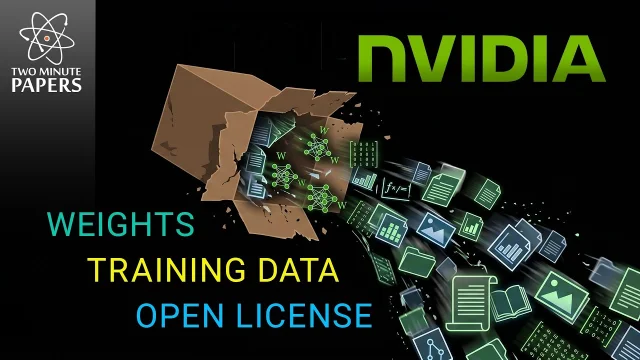
Nemotron 3 Ultra is NVIDIA's latest open model: 550 billion parameters, 1 million token context window, and — the actually notable part — licensed under OpenMDW, which is essentially Apache 2.0 adapted for ML weights. Commercially unrestricted, derivative works allowed, no funny business. 9
The technical choices that make it fast: Mixture of Experts (only ~10% of parameters active per token), Mamba layers for memory-efficient long-context processing, and NVFP4 low-precision arithmetic. The result is a model that runs fast but requires serious hardware — hundreds of GB of GPU VRAM.
Two Minute Papers ran the model against coding tasks and came away mixed: it failed basic light simulation and real-time strategy game rendering that smaller models handle fine. Where it shines is everything adjacent to coding — terminal troubleshooting, quick experiments, file organization — plus tasks requiring a long context window.
The reviewer's honest framing: you don't need one model for everything. Nemotron 3 Ultra fills a specific slot — fast, open, long-context, permissively licensed — not a general-purpose replacement for your current stack.
Worth watching? Yes if you care about open models. The benchmark skepticism and honest failure reporting are refreshing. Watch at 1.5x — the pacing is deliberately slow.
参考来源
- 1Matthew Berman: Only the best are using them
- 2Peter Steinberger on X (5M views)
- 3Matthew Berman: open-source AI projects
- 4Last30Days on GitHub
- 5Agent Skills on GitHub
- 6Headroom on GitHub
- 7Anthropic: Fable and Mythos access update
- 8Wall Street Journal: Amazon CEO raised Mythos concerns
- 9NVIDIA Nemotron 3 Ultra research page
围绕这条内容继续补充观点或上下文。