
Three Shutdowns: Seaweed Yarn, Bitcoin DeFi, and a Penguin Game
This week: Keel Labs (~$15M, biomaterials/fashion-tech) filed Chapter 11 after 9 years of award-winning seaweed fiber that brands admired but never mainline-procured; Botanix Labs ($11.5M, Bitcoin L2) voluntarily wound down after TVL collapsed from $26.3M to $47K when the market decided WBTC on Ethereum was good enough; Pudgy Party (1M+ downloads, web3 gaming) phased out as its parent company pivoted to a new product line. Three cases, one dominant root cause: building something technically impressive that the market didn't need to replace.
Three companies announced they were closing this week — Jun 8–15, 2026 — spanning fashion-tech, crypto infrastructure, and web3 gaming. Each had real traction at some point. None failed for the same reason.
Keel Labs (founded 2017) filed Chapter 11 in North Carolina on June 5 after revenue collapsed from $139K in 2024 to near zero. 1 Botanix Labs (founded 2022) announced June 9 that it was winding down its Bitcoin Layer-2 network after TVL (total value locked — the dollar value of crypto assets deposited in a protocol) fell from a $26.3M peak to $47K. 2 Pudgy Party, the mobile game run by Igloo Inc. (parent of the Pudgy Penguins NFT brand), announced June 12 it was halting development — despite 1M+ downloads and an App Store #1 ranking — to redirect resources to Pudgy World. 3
Two of the three cases trace to the same root cause: product-market mismatch. Keel Labs built a biomaterial that generated 500+ inbound inquiries from fashion brands but converted almost none into revenue. Botanix built EVM infrastructure for Bitcoin holders who turned out to prefer using WBTC on Ethereum. Pudgy Party is a different failure type — resource reallocation from a parent brand betting on a different product line — but it sits inside the same broader dynamic: building something users try but don't keep choosing.
| Company | Founded | Total raised | Core product | Shutdown type | Root cause |
|---|---|---|---|---|---|
| Keel Labs | 2017 | ~$15M | Seaweed-derived textile fiber (Kelsun™) | Chapter 11 bankruptcy | Product-market mismatch |
| Botanix Labs | 2022 | $11.5M | Bitcoin EVM Layer-2 (Spiderchain) | Voluntary wind-down | Product-market mismatch |
| Pudgy Party | Est. ~2023 | Not publicly disclosed | Web3 mobile party game | Phased shutdown | Resource reallocation / mistimed market |
Keel Labs: $15M, 500 brand inquiries, $139K in revenue
The company
Aleks Gosiewski and Tessa Callaghan met at the Fashion Institute of Technology (FIT) in New York in 2015. Both had worked in the fashion industry — Callaghan held knit design roles at Helmut Lang and Perry Ellis — and both were frustrated by textiles' environmental footprint. They won the inaugural Biodesign Challenge in 2016 and founded AlgiKnit (later renamed Keel Labs) in 2017. 4 A third co-founder, Aaron Nesser, was involved in the early days before departing.
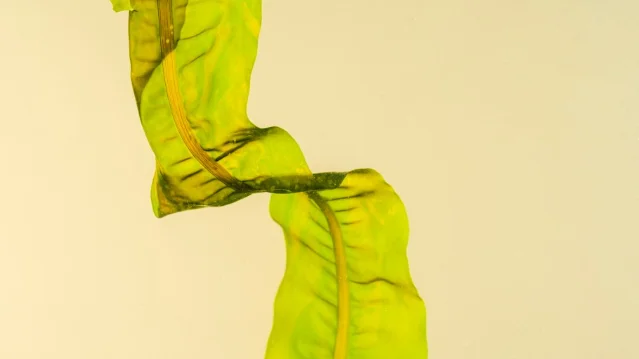
The core technology was Kelsun™, a fiber spun from kelp — the family of large brown seaweeds. Kelp grows fast without freshwater or fertilizer, and Kelsun was intended as a drop-in replacement for cotton or nylon in standard industrial knitting machines. The pitch was strong on both environmental and industrial grounds: reduced land use, lower carbon intensity, and compatibility with existing supply chains.
Fundraising reflected genuine industry enthusiasm. A $2M seed round in November 2018 included Founders Fund, SOSV, Astanor Ventures, and Future Shape. 5 In June 2022, Keel Labs raised a $13M Series A led by Collaborative Fund's Sophie Bakalar, with H&M Group Ventures and Li Ka-shing's Horizons Ventures participating. 5 Total funding reached approximately $15M (one source cites $18M; WWD bankruptcy filings support the $15M figure). The company relocated from New York to Morrisville, North Carolina, and hired 21–50 employees. Gosiewski and Callaghan were named to Forbes 30 Under 30 in the manufacturing category in 2022. 4
Key events timeline
- Oct 2023: Stella McCartney debuted Kelsun-fiber garments at Paris Fashion Week for Summer 2024. 6 McCartney personally holds 0.8% of Keel Labs equity (as Stella Nina Willis). 1
- Sep 2024: First commercial product: a $228 Universal Blanket Shirt with California surf brand Outerknown, a limited run. 7
- Jul 2025: H&M's & Other Stories brand released a Kelsun crochet beach set — the first mass retail appearance of the fiber. 6 Gosiewski said at the time: "At the end of the day, our goal is simple: we want to create materials that allow fashion brands to meet their sustainability goals without compromising on quality or performance." 6
- Nov 2025: Keel Labs vacated its Morrisville office. 1
- Mar 2026: Landlord SBP Office Owner sued in Wake County, alleging Keel Labs refused to pay $323K in past-due rent. 1
- Jun 5, 2026: CEO Aleks Gosiewski signed the Chapter 11 petition. Assets: ~$1.4M. Liabilities: ~$337K. 1
The revenue collapse
Keel Labs' annual revenue figures, disclosed in the bankruptcy filing, tell the actual story: 1
- 2024: ~$139,000
- 2025: <$17,000 (roughly 88% decline year over year)
- 2026 (pre-filing): "essentially no revenue"
Against $15M raised over eight years, the peak annual revenue was less than 1% of total capital deployed. The company received more than 500 inbound inquiries from global brands — and translated that into two limited commercial launches: the Outerknown shirt in September 2024 and the & Other Stories beach set in July 2025.
Gosiewski did not respond to media requests for comment after the filing. 1
Root cause: product-market mismatch
Keel Labs is the latest in a series of next-gen materials companies to collapse despite brand partnerships and investor confidence. Renewcell (Swedish textile recycler) filed for bankruptcy in February 2024 despite H&M and Zara as clients. Bolt Threads shut down Mylo, its mushroom-leather product, in June 2023 despite backing from Stella McCartney, Lululemon, and Adidas. 8
The structural problem these companies share is not technical failure — Kelsun worked in industrial knitting machines. The problem is the distance between a brand's willingness to try a material in a limited capsule run and its willingness to commit to commercial-scale procurement.
Brittany Sierra, founder of the Sustainable Fashion Forum, put it directly after the Keel Labs filing: "generating industry interest and generating commercial demand are not always the same thing." 8
Ganni co-founder Nicolaj Reffstrup articulated the brand side of this gap in a 2024 interview: "Can the product be brought to market and fit into existing infrastructure, in the supply chain? If not, it can't be used." 9
Keel Labs never crossed that line. Seaweed fiber costs more to produce than conventional alternatives, blending it with cotton creates recycling complications, and scaling to the volume sizes brands require for mainline production had not been solved by the time capital ran out. 6 The $15M raised from 2018 to 2022 was deployed before the company found out whether brands would actually order at scale. They didn't.
Actionable lesson: In deep-tech materials, pilot partnerships and press coverage are not demand signals. A brand agreeing to a limited capsule run in a sustainability showcase is a PR decision, not a procurement decision. Founders should require binding volume commitments — with price floors and minimum order quantities — before counting any "500 interested brands" as evidence of product-market fit. The test question: if your current partners stopped buying tomorrow, what's your revenue? For Keel Labs in 2025, the answer was $17,000.
Botanix: $11.5M, 25M transactions, $47K TVL
The company
Willem Schroe, Alisia Painter, and Armin Sabouri (CTO) founded Botanix Labs in New York in 2022. Schroe, a Belgian Harvard alumnus, had witnessed hyperinflation firsthand in Lebanon and wanted to build a financial system that ran on Bitcoin's security while enabling the programmable applications that Ethereum had demonstrated. 10
The product was Spiderchain — an EVM-compatible Bitcoin Layer-2 that used a decentralized multisig mechanism to bridge Bitcoin into a programmable environment without modifying Bitcoin's base layer. Each Bitcoin block generated a new multisig wallet; Orchestrator nodes rotated randomly to prevent collusion. The architecture was technically sound and clearly differentiated from older approaches like Rootstock. 11
Fundraising timeline:
- Jun 2023: $3M pre-seed (SAFE), from Edessa Capital, UTXO Management, XBTO Ventures, Eric Wall, and others 12
- May 7, 2024: $8.5M seed round led by Polychain Capital, Placeholder Capital, Valor Equity Partners, and ABCDE. Angel investors included Andrew Kang, Dan Held, and Domo (creator of the BRC-20 token standard). 10 Total raised: $11.5M from 31 investors. 12
Schroe framed the vision at the seed close: "Our team at Botanix Labs is driven by the mission of building the infrastructure that supports a global financial system running on Bitcoin for the next 100 years." 10
Botanix never issued a token — a deliberate choice to avoid the incentive-farming dynamics that inflated and then collapsed TVL on many competing networks. 2
Key events timeline
- Nov 2023: Testnet launched. Over 200K active addresses and 10K experimental token deployments followed. 2
- ~Jun 2025: Spiderchain mainnet launched. Integrated Chainlink, Morpho, GMX, Dolomite, Fireblocks, Alchemy, Galaxy, and OKX Wallet. 2
- Sep 2025: TVL peaked at approximately $26.3M. 13
- ~May 2026: BINK, a self-custodial Bitcoin neobank app, launched on iOS and Android — just weeks before the shutdown decision. 2
- Jun 9, 2026: Botanix published its wind-down announcement. Users have until July 9 to withdraw; after that date, the Federation will reclaim remaining BTC, and other assets become unrecoverable. 2
The TVL collapse
At shutdown, Botanix's TVL had declined from its $26.3M peak to approximately $47K — a 99.8% drop. 13 The network's 24-hour fee revenue on its final days was $9. 13 Twenty-four-hour DEX volume: $0. The mainnet had processed approximately 25 million transactions across 200K wallets during its year of operation — all organic growth with no token incentives — but the economic activity generated was insufficient to cover infrastructure costs. 2
コンテンツカードを読み込んでいます…
Root cause: product-market mismatch
Botanix's wind-down post, running roughly 2,500 words, is a rare document: a team that raised $11.5M explaining, with unusual specificity, why their market did not materialize. Five lessons emerged from the statement:
1. Bitcoin's market conversation hasn't moved beyond store of value. The protocol needed Bitcoin holders to think of their BTC as programmable capital, not a savings account. "We would rather stop now, with integrity intact and resources available to take care of the people who took a chance on us, than push the experiment past the point where it still has something to teach us." 2
2. WBTC already solved the user's problem. For borrowing, yield, and leverage, wrapping Bitcoin on Ethereum was cheaper and easier than bridging to a native Bitcoin L2. "Decentralisation matters to people in principle and in conversation; in practice, when something cheaper and easier is in front of them, they use it." 2
3. Token issuance was off the table. Botanix had planned to issue a token when PMF was established — treating it as "closer to an IPO than an airdrop." That threshold was never reached, and by 2025–2026 the market had stopped rewarding even disciplined token issuance. 2
4. On-chain activity is consolidating away from base infrastructure. "The on-chain economy is consolidating around venues that own the user relationship: Hyperliquid, Robinhood, the major CEXes, and now TradFi participants absorbing an ever-larger share of attention, flow, and revenue." 2 Any team building base-layer infrastructure is working against that consolidation.
5. Bitcoin user economics don't generate fee income. Bitcoin users primarily hold for appreciation and seek yield through simple mechanisms. High-frequency trading — the behavior that generates the fee income Layer-2 networks need — is not characteristic of Bitcoin holder behavior. 2
The honest core of the post-mortem: "The honest answer we have arrived at, after living inside it every day, is that it did not work, at least not in this market and not on this timeline." 2
Decrypt and CoinDesk both noted Botanix's closure adds to the list of Bitcoin L2 failures. The sector's other survivors — Stacks, Rootstock, Liquid Network — predate the 2022–2024 wave by years and occupy different market positions. 14 Newer approaches (Citrea, Alpen Labs) remain in early stages with the same fundamental question unanswered: does the Bitcoin holder base actually want DeFi? 15
Actionable lesson: Before building infrastructure for an asset-holder base, verify whether those holders want to use their asset as working capital — or whether they want to hold it and occasionally earn yield through the simplest available mechanism. Botanix's error wasn't technical; the Spiderchain ran for a year with 100% uptime and zero security incidents. 2 The error was assuming that because Bitcoin holders would theoretically benefit from a programmable Bitcoin layer, they would actively seek one. The concrete test: find 50 Bitcoin holders who currently use WBTC on Ethereum. Ask them what problem they'd pay to have solved that WBTC doesn't solve. If fewer than 10 can name one, you don't have a market.
Pudgy Party: 1M+ downloads, then a strategic pivot
The company
Pudgy Party was a mobile game released by Igloo Inc. — the company behind the Pudgy Penguins NFT collection, one of the most recognized brands in the NFT space. The game launched to #1 on the App Store and accumulated over 1 million downloads. 3 Pudgy Penguins itself is a collection of 8,888 penguin-themed NFTs that became a top-tier PFP (profile picture) project; Igloo Inc. extended the brand into physical toys, brand licensing, and gaming.
Total funding for Pudgy Party specifically is not publicly disclosed. Igloo Inc. has raised capital across multiple rounds, but the gaming division's separate financials have not been made public.
Key events timeline
- ~2023–2024: Pudgy Party developed and launched as a mobile web3 game, integrating the Pudgy Penguins IP.
- App Store peak: Reached #1 on the App Store charts; 1M+ downloads accumulated. 3
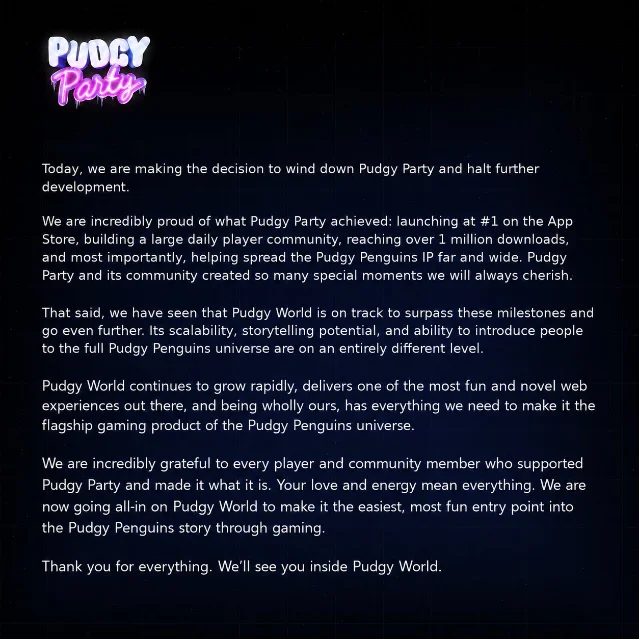
- Jun 12, 2026: Igloo Inc. announced phased shutdown of Pudgy Party and halt of all further development. 3 The announcement garnered 499K views, 847 likes, and 328 replies. 16
The decision logic
The shutdown statement was brief and calibrated: "We have seen that Pudgy World is on track to surpass these milestones and go even further. Its scalability, storytelling potential, and ability to introduce people to the full Pudgy Penguins universe are on an entirely different level." 3
And directly: "continuing to invest in this product is not the optimal way to expand the influence of the Pudgy Penguins IP." 16
This framing matters. Unlike Keel Labs and Botanix, Pudgy Party's shutdown is not a PMF failure in the conventional sense — 1M downloads with an App Store #1 proves the game attracted users. The argument being made is that Pudgy World is a better bet for the same resources, and maintaining Pudgy Party creates an opportunity cost Igloo is unwilling to keep paying.
Root cause: resource reallocation / mistimed market
The mechanics here are closer to a corporate portfolio decision than a startup death. Igloo Inc. is managing a brand across multiple products and determined that running two simultaneous gaming experiences split focus without proportional upside.
The broader context: NFT-based gaming has struggled to retain users even when initial download numbers are strong. Market attention in the NFT space has shifted toward newer inscription-based assets and utility-focused projects; traditional PFP collections have seen trading volume fall sharply since the 2021–2022 peak. 17 Pudgy Party's 1M downloads were accumulated in a market environment where web3 mobile games were a growth category; by June 2026, the question of whether those downloads converted into a retained, paying audience is unresolved in the public record.
The community reaction was mixed but not hostile. One web3 operator with prior experience at Polygon and Billions Network commented: "Great companies are defined as much by what they kill as what they launch" and "Focus and speed are the 2 most important skills for a successful startup." 18 That reaction is common when a brand with recognized standing makes a consolidation move — the market tends to grant more credibility to IP-driven pruning decisions than to pure-play gaming company shutdowns.
Actionable lesson: When a parent brand has multiple simultaneous bets, "early traction" is not enough to justify continued resource allocation — the bar is whether this product is the best use of the same team, money, and brand credibility versus an alternative. Founders running sub-products under a parent brand should define upfront what the threshold is for killing a product line: a minimum DAU retention rate, a revenue per user floor, or a comparison metric against the competing internal initiative. Without that threshold set in advance, the decision becomes political rather than analytical — and it always arrives later than it should.
What these three cases share
Two root causes, three cases. The Keel Labs and Botanix failures are structurally similar despite being in different industries: both companies built real technology, attracted credible investors and partners, demonstrated user-level traction, and ran out of runway before they found customers who would pay at commercial scale. The failure mode is "interest without conversion."
The distinction between the two is instructive:
- Keel Labs generated 500+ brand inquiries and had H&M, Stella McCartney, and Outerknown as partners — but couldn't cross from PR-grade adoption (limited capsule runs, runway shows) to procurement-grade adoption (mainline seasonal orders).
- Botanix generated 25M transactions and 200K wallets — but couldn't cross from "trying out" to "depending on," because WBTC on Ethereum already served the core use cases more cheaply.
In both cases, the metric that looked like PMF (brand inquiries for Keel; wallet counts for Botanix) was a proxy that didn't measure the behavior that actually drives revenue. Brands agreeing to experiment is not the same as brands placing orders. Wallets connecting to a testnet or exploring a mainnet for curiosity is not the same as users choosing to route their primary activity through a network.
The Pudgy Party case is structurally different: a resource reallocation within a functioning brand. Igloo Inc. isn't failing; it's concentrating. The lesson for founders is less about PMF and more about how to define "success" for a sub-product so that the kill decision is clear when it should be made.
Across all three cases, the failures were structurally locked in well before the public announcement: Keel Labs had essentially no revenue going into 2026; Botanix TVL was in freefall for nine months before the June statement; Pudgy Party's fate likely followed Pudgy World's strategic priority shift by months. The announcement date is the last step of the process, not the moment of failure.
| Keel Labs | Botanix | Pudgy Party | |
|---|---|---|---|
| Real traction achieved? | Yes — 500+ brand inquiries, Stella McCartney runway | Yes — 25M txns, 200K wallets, $26.3M TVL peak | Yes — App Store #1, 1M+ downloads |
| Revenue at shutdown | <$17K (2025 full year) | $9/day in fees | Not disclosed |
| Critical conversion failure | Pilot → mainline procurement | Try → depend (WBTC was sufficient) | N/A (resource reallocation) |
| Root cause taxonomy | Product-market mismatch | Product-market mismatch | Mistimed market / resource reallocation |
| Time between terminal event and announcement | ~6 months (revenue stopped) | ~9 months (TVL collapse Sep 2025) | Unknown (weeks to months) |
参考ソース
- 1WWD: Seaweed Yarn Maker Keel Labs Files for Chapter 11 Bankruptcy
- 2Botanix (@botanix): Official wind-down statement
- 3@PlayPudgyParty on X: shutdown announcement
- 4Inc. Magazine: How Keel Labs Is Using Seaweed to Make Clothes
- 5Startup Intros: Keel Labs — Funding, Team & Investors
- 6Sustainability Magazine: H&M & Keel Labs: Using Seaweed In Sustainable Fashion
- 7Trellis: Fashion innovators turn to these next-gen climate-friendly materials
- 8The Sustainable Fashion Forum: What Happened in Sustainable Fashion News This Week
- 9Vogue Business: Here's why Ganni is taking a break from showing this season
- 10The Block: Botanix Labs raises $8.5M to build a Bitcoin-native DeFi ecosystem
- 11IQ.wiki: Botanix Labs
- 12Messari: Botanix Labs Funding
- 13DeFiLlama: Botanix — TVL, Fees & Revenue
- 14Decrypt (via Yahoo Finance): Botanix Will Shut Down Bitcoin Layer-2 Network in July
- 15BeInCrypto: 5 Hard Truths Why Bitcoin DeFi Isn't Working As Botanix Layer 2 Shuts Down
- 16WuBlockchain: Weekly Project Updates, Jun 13 2026
- 17BlockchainReporter: Weekly Recap — Botanix Wind-Down and Pudgy Party Closure
- 18@jgonzalezferrer on X: commentary on Pudgy Party shutdown
このコンテンツについて、さらに観点や背景を補足しましょう。